


Davos Transportation, Owned End to End
Vetted Professional Chauffeurs
LiveOps Trip Visibility
24/7 Client Care


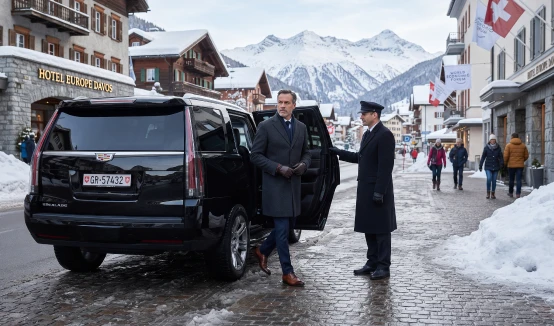
Davos transportation should be planned as one connected movement from the executive's arrival in Switzerland through their final departure. Companies should coordinate commercial or private aviation with onward ground transportation, determine which executives require dedicated vehicles, establish what chauffeur and vehicle information Corporate Security needs, and account for changing local access conditions. Different members of the same delegation may require different transportation even when they are attending the same event. The priority is preparedness, visibility, and clear accountability for every movement.
Nearly 3,000 leaders from more than 130 countries attended the 2026 World Economic Forum Annual Meeting in Davos, including 64 heads of state and government and approximately 830 CEOs and chairs (World Economic Forum, 2026).
That concentration of global leadership creates an operating environment where transportation, aviation, security, and executive movement cannot be treated as separate pieces.
For Corporate Security, Flight Departments, and Executive Offices, the objective is not simply to secure vehicles in Davos. Savoya's experience supporting complex global executive movement has shown that the work starts earlier: establishing control over the transportation operation before the delegation arrives.
A Davos itinerary does not begin at the hotel.
Senior executives may arrive separately through commercial or private aviation, accompanied by security or support personnel following different schedules. Those arrivals need to connect with onward ground transportation and the executive's first commitments.
Planning each transfer independently creates unnecessary handoffs. Instead, map the delegation. Establish who arrives when, who travels together, which executives require independent vehicles, what security requirements apply, and how departure movements reconnect with aviation.
This is how Savoya approaches complex international programs: the transportation provider should understand the movement as a whole rather than treating each reservation as an isolated trip.
For Corporate Security, receiving a chauffeur name and vehicle confirmation is the beginning of transportation oversight, not the end.
The team needs confidence in who is operating the vehicle, what standards sit behind that chauffeur, whether the vehicle is positioned as expected, and who is responsible when an access condition or itinerary changes. If Security has to gather that information from multiple disconnected providers, transportation has created another operational burden instead of removing one.
Savoya provides professional chauffeur standards, LiveOps trip visibility, flight monitoring, and 24/7 Client Care within one transportation operation. Across 350+ markets, that model allows organizations to maintain a consistent standard even when the executive's itinerary crosses markets and providers behind the scenes.
The client should not have to assemble that network themselves. That is part of the responsibility they are handing to Savoya.
Finding a vehicle is not the same as having an operation prepared for Davos.
Availability answers whether someone can accept the trip. Preparedness asks whether the transportation provider understands the arrival plan, executive delegation, access environment, chauffeur requirements, schedule dependencies, and process for responding when one of those conditions changes.
That distinction matters because no provider can promise that Davos will operate exactly according to plan. Security controls, routing, weather, aviation, and executive schedules introduce variables outside any transportation company's control.
Through more than one million completed trips, Savoya has learned that the strongest transportation operations are built around what can be controlled: preparation before those variables appear and clear responsibility when they do.
That is where Savoya's service model is designed to perform.
The objective is not to eliminate every variable. That would be an unrealistic promise.
The objective is to prevent those variables from becoming fragmented responsibilities across the Executive Office, Corporate Security, Flight Department, chauffeurs, and multiple local providers.
Savoya's role is to sit across that transportation operation, connect the relevant information, maintain visibility, and provide a clear point of accountability when the plan changes.
For an executive delegation operating in an environment like Davos, the most valuable transportation capability is not simply having a car available. It is knowing that someone owns the movement from beginning to end.
That is the standard Savoya brings to the program.
World Economic Forum. 2026. Annual Report 2025–2026: Events. September 1, 2026. https://www.weforum.org/publications/annual-report-2025-2026/in-full/events/
World Economic Forum. 2026. Annual Meeting 2026: A Spirit of Dialogue. January 23, 2026. https://www.weforum.org/press/2026/01/annual-meeting-2026-a-spirit-of-dialogue-ceb3ae9c08/
One account means one invoice, one set of standards, and one point of contact. Savoya centralizes billing and reporting by traveler, cost center, and market so your team spends less time reconciling charges and more time managing the program.
Savoya obscures personal contact information through its mobile app, requires signed confidentiality agreements from all chauffeurs, and enforces company-wide privacy policies. Security teams receive advance chauffeur and vehicle details for positive identification.
Events require dedicated coordination, event-specific dashboards, and backup vehicle planning. Savoya assigns a concierge team and monitors every trip in real time so multi-day conference programs don't fall apart after day one.
Savoya tracks flights with ADS-B data and automatically adjusts chauffeur pickup times when the aircraft moves. Changes are reflected in the system and communicated to the chauffeur directly, without requiring a phone call.
Yes. Savoya operates in 350+ markets across six continents on a single account. The same vetting standards, technology, and trip visibility apply whether you book in Dallas, London, or Tokyo.
Ask for specifics: background checks, drug screenings, insurance validation, and confidentiality agreements. Savoya runs a 14-Point Vetting System and accepts fewer than two percent of applicants. Request documentation rather than relying on marketing language.

Vetted Professional Chauffeurs
LiveOps Trip Visibility
24/7 Client Care




© 2026 Savoya. All rights reserved.