


Service Shouldn’t End at Confirmation.
24/7 Client Care
Live trip monitoring
Pre-vetted chauffeurs
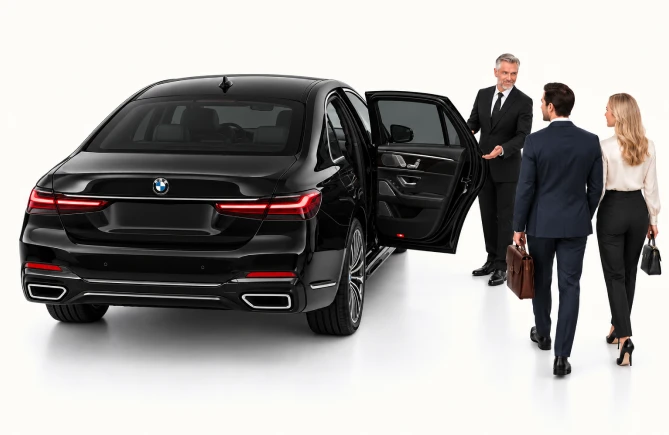
See how service, technology, and accountability work together.


Executive transportation has never been more accessible.
Organizations can book ground transportation in hundreds of cities through a mobile app, compare providers in minutes, receive automated trip updates, integrate reservations into broader travel programs, and increasingly use AI to simplify planning and coordination. At the same time, business travel itself continues to evolve, with organizations investing in technology, automation, and more sophisticated travel programs to improve efficiency and support growing executive movement. According to recent research from the Global Business Travel Association, corporate travel leaders entered 2026 with stronger confidence but also greater constraint, as cost, complexity, technology, and traveler expectations continued to shape the business travel environment (GBTA, 2026).
By almost every operational measure, the industry has made remarkable progress.
Yet despite all of these advancements, the conversation surrounding executive transportation has remained surprisingly narrow.
The industry continues to compete on the same dimensions it has for years: broader coverage, larger fleets, faster booking experiences, newer technology, lower prices, and more features. These capabilities matter, and they have unquestionably made transportation easier to purchase. The challenge is that they have increasingly become the primary way providers differentiate themselves, even though they represent only part of what creates an exceptional executive transportation experience.
But they have not answered a more fundamental question.
What actually creates a better executive transportation experience?
For much of the industry, transportation has become a technology problem to solve.
We believe the industry’s greatest opportunity has always been solving the service problem.
Over the past two decades, the executive transportation industry has experienced many of the same forces reshaping business travel as a whole. Digital booking platforms have matured. Mobile technology has transformed the reservation experience. Artificial intelligence is beginning to automate administrative tasks that once required significant manual effort. Corporate travel programs have become more integrated, connected, and data-driven.
These developments have unquestionably made executive transportation more efficient. They have also raised expectations, making technology, visibility, and operational efficiency essential components of any modern executive transportation provider.
They have also made many transportation providers look increasingly similar.
Today, nearly every provider promises broad geographic coverage, modern booking technology, real-time notifications, and an expanding network of vehicles. These capabilities have become table stakes for competing in executive transportation, and they remain essential investments. Innovation has largely focused on making reservations faster, expanding availability, and improving operational efficiency. That investment has improved how transportation is purchased, but it has not fundamentally changed how executive transportation is experienced.
That distinction matters because executive transportation is rarely evaluated by how easy it was to book. It is remembered by how effectively it was managed after the reservation was made.
Technology has transformed many aspects of corporate travel, but responsibility has never been something that could be automated. Executive Assistants still carry the pressure of supporting demanding executive schedules. Travel Managers are still responsible for maintaining consistency across complex programs. Meeting Planners continue coordinating dozens or hundreds of moving pieces where one delayed arrival can affect an entire event. Chiefs of Staff still balance competing priorities where timing, discretion, and reliability matter far beyond the transportation itself.
The people behind executive transportation have not become less responsible simply because the reservation process has become easier. In many ways, they have become more responsible.
Business Travel News reported in 2026 that AI has moved from novelty toward necessity in managed travel, but adoption remains uneven, with many programs still experimenting and few fully embedding AI into workflows or documenting clear ROI. That tension matters. The tools are improving, but the human burden has not disappeared (Davis, 2026).
Executives expect faster responses. Travel moves more quickly. Schedules change more frequently. Expectations continue to rise. Technology has accelerated the pace of business, but it has not reduced the need for judgment, accountability, or trusted partnerships.
This is where the industry conversation begins to separate.
Transportation is the movement of a passenger from one location to another. Service is everything required to ensure that movement supports the people responsible for making it successful.
Service appears long before a chauffeur arrives. It appears in the standards established for vendors, the people monitoring active trips, the way schedule changes are managed, how issues are resolved, how communication is handled, and how consistently an organization delivers the same experience regardless of where an executive travels.
These are not features. They are operating philosophies.
Yet they receive far less attention than booking technology, fleet size, or geographic coverage because they are significantly more difficult to quantify and considerably harder to replicate. The strongest executive transportation providers invest in both. Technology enables visibility, efficiency, and coordination, while service determines how those capabilities are delivered when people depend on them most.
Technology can often be purchased. Coverage can be expanded. Applications can be redesigned. A culture built around service cannot.
The transportation industry has made major progress in making rides easier to reserve. The more important question is whether it has made executive transportation easier to trust.
The executive transportation industry does not need less innovation. It needs a broader definition of what innovation actually means.
The next generation of industry leaders will certainly continue investing in technology, automation, and operational efficiency. Those investments remain essential. The organizations that create lasting relationships will continue investing in those capabilities while recognizing that technology delivers its greatest value when it strengthens exceptional service rather than attempting to replace it.
Because when executives arrive exactly as planned, when meetings begin on time, when travelers never experience disruption, and when the professionals coordinating those experiences can focus on their work instead of managing their transportation provider, the value being delivered extends well beyond the reservation itself.
That is the difference between moving people efficiently and supporting people exceptionally.
It is also the distinction that ultimately inspired Savoya’s founding.
While much of the industry continued improving the mechanics of transportation, Savoya was built around a different belief: meaningful service should never be treated as an amenity. It should be the standard by which executive transportation is measured. That philosophy has never meant choosing service instead of technology. It has meant investing in technology, visibility, and operational capabilities that strengthen service, improve accountability, and make it easier for the people coordinating executive transportation to do their jobs with confidence.
That philosophy became the foundation of the company and continues to shape how we support the people responsible for executive transportation every day.
References
Arena, Lauren, and Andy Hoskins. 2025. “The 2026 Outlook.” Business Travel News Europe, December 19, 2025. https://www.businesstravelnewseurope.com/Management/The-2026-Outlook.
Davis, Chris. 2026. “BTN’s 2026 Corporate Travel AI Survey.” Business Travel News, April 20, 2026. https://www.businesstravelnews.com/AI-Report-2026/BTNs-2026-Corporate-Travel-AI-Survey.
Ferrara, Kate, Eileen Crowley, Matt Josephson, Matt Soderberg, Stephen Rogers, and Maggie Rauch. 2026. “2026 Travel Industry Outlook.” Deloitte Insights, February 5, 2026. https://www.deloitte.com/us/en/insights/industry/transportation/travel-hospitality-industry-outlook.html.
Iannaci, Debbie. 2026a. “Global Business Travel Professionals Signal Stronger Confidence But Also Constraint Heading Into 2026, According to Latest GBTA Poll.” Global Business Travel Association, January 27, 2026. https://gbta.org/global-business-travel-professionals-signal-stronger-confidence-but-also-constraint-heading-into-2026-according-to-latest-gbta-poll/.
Iannaci, Debbie. 2026b. “Corporate Travel Policies Strengthen, Modernize and Embrace AI—While Opportunities Remain for Improving Accessibility, Policy Clarity and Compliance.” Global Business Travel Association, March 5, 2026. https://gbta.org/corporate-travel-policies-strengthen-modernize-and-embrace-ai%E2%94%80while-opportunities-remain-for-improving-accessibility-policy-clarity-and-compliance/.
One account means one invoice, one set of standards, and one point of contact. Savoya centralizes billing and reporting by traveler, cost center, and market so your team spends less time reconciling charges and more time managing the program.
Savoya obscures personal contact information through its mobile app, requires signed confidentiality agreements from all chauffeurs, and enforces company-wide privacy policies. Security teams receive advance chauffeur and vehicle details for positive identification.
Events require dedicated coordination, event-specific dashboards, and backup vehicle planning. Savoya assigns a concierge team and monitors every trip in real time so multi-day conference programs don't fall apart after day one.
Savoya tracks flights with ADS-B data and automatically adjusts chauffeur pickup times when the aircraft moves. Changes are reflected in the system and communicated to the chauffeur directly, without requiring a phone call.
Yes. Savoya operates in 300+ markets across six continents on a single account. The same vetting standards, technology, and trip visibility apply whether you book in Dallas, London, or Tokyo.
Ask for specifics: background checks, drug screenings, insurance validation, and confidentiality agreements. Savoya runs a 14-Point Vetting System and accepts fewer than two percent of applicants. Request documentation rather than relying on marketing language.

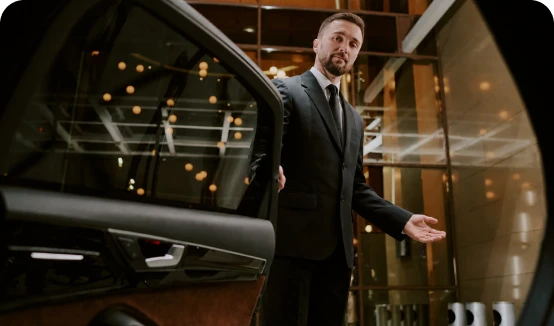
24/7 Client Care
Live trip monitoring
Pre-vetted chauffeurs




© 2026 Savoya. All rights reserved.